What Causes Moiré Fringing?
What is Moiré Fringing and How Can It Be Mitigated?

Moiré fringing is the interference that can happen between the pixel structure of a display and the grid pattern of the shielding mesh if the mesh isn’t correctly aligned with the pixel composition. It’s like what happens when you take a photo of your laptop screen and all those unusual rainbow waves appear.
Source and Etymology
According to Merriam-Webster’s dictionary, the word moiré comes from 17th century French and was used to refer to a particular type of cloth that was silky and wavy, with those shiny rainbow patterns seen when grids or pixels are overlaid in opposing or conflicting orientations.

Why Is Moiré Fringing Relevant to Optical Bonding and Shielding?
In order to shield sensitive displays from Electromagnetic and Radio Interference, mesh is often used, and when that mesh isn’t correctly aligned or isn’t the right shape, moiré fringing can occur, which lowers the optical clarity of the display.
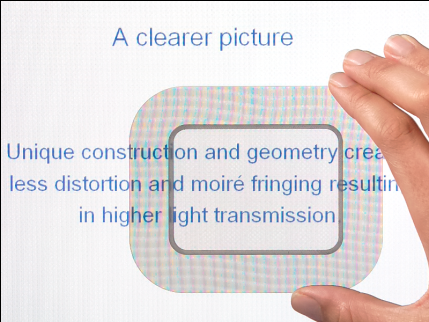
EmiClare® Mesh Family
Our EmiClare mesh family was designed to reduce moiré fringing. MicroMesh®, the signature product of the EmiClare line, is a perfectly micro-replicated conductive grid, and further minimises the risk of fringing.
It’s important that whatever mesh is being applied to a display, the bias angle is accurately determined. Bias angle is the angle at which the mesh is laid across the display. Based on the type of display, we can advise the best angle and experiment to ensure that optical clarity is not compromised. Generally, 36 degrees matches the display and grid. Once the angle is set and measured, our skilled operators can build the optical stack with the defined angle. Instead of moiré fringing, it’s more optical clarity.
Depending on the display and the shielding level necessary, different meshes can be used. Check out our full line here and contact us if you have any questions.

The appearance of U.S. Department of War visual information does not imply or constitute DOW endorsement.